


On this page
How does a gym make money online? The same way it makes money offline: mostly through recurring memberships, topped up with extras. Online, those memberships and extras become an online-only or hybrid membership, single training programmes, rentals, class packs, paid live classes and vouchers for trials or company deals. In this article we compare the traditional gym revenue model with the online one, and show how gyms combine the two into a model that works.
The traditional gym revenue model: memberships
Physical gyms have always relied on the subscription model. Members pay a fixed amount per month, sometimes with a minimum term, and the price depends on the level of access. Most gyms offer a basic membership and earn extra from add-ons such as:
- group classes or access to more locations
- personal training sessions
- drinks, supplements or merchandise
- joining fees and premium tiers with extra facilities
The strength of this model is predictable recurring revenue. The weakness is that it is tied to a building: your revenue is limited by your floor space, your opening hours and the number of people who live close enough to visit.
Why gyms add an online offer
Many members now train both at the gym and at home, while travelling or outside opening hours. An online offer lets you serve them there too. It also opens up new revenue that doesn’t depend on your building:
- Reach beyond your area: people who will never visit your location can still subscribe to your classes.
- Better retention: members who can keep training during holidays or busy weeks have fewer reasons to cancel.
- More value from your instructors: a class recorded once can be watched many times.
- Your own audience data: you see what members watch, which helps you plan classes and campaigns.
Online revenue models for gyms
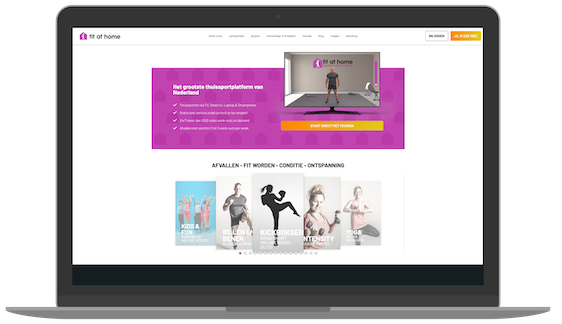
An online gym platform is not limited to one way of charging. These are the models gyms use most:
- Online membership (SVOD): a monthly, quarterly or yearly subscription for access to your full library of workouts. This is the online version of the classic membership.
- Hybrid membership: online access included in a premium in-gym membership, or offered as a paid add-on to it.
- Single programmes (TVOD): a one-off purchase for a specific programme, such as an eight-week strength plan or a beginners’ series.
- Rentals: access to a workout or programme for a set period.
- Credits or class packs: members buy credits and spend them on the classes they choose.
- Paid live classes: sell tickets for a live session or include it in a membership, and offer the recording on demand afterwards.
- Vouchers and company deals: free trials, discount codes and corporate wellness packages that bring in new members.
Advertising is rarely a good fit for a gym. Your audience is usually too small for ad revenue to add up, and ads get in the way of a workout. Free content works better as marketing: a few open workouts that convince people to sign up.
How to combine models
Most successful online gyms don’t pick one model; they stack them. A common structure looks like this:
- Free: trailers and a handful of sample workouts to attract new visitors.
- Core: an online membership with a steady release schedule, with a discount for yearly payment.
- Premium: specialist programmes or challenges sold separately, also to non-members.
- Events: live classes or workshops with a ticket, later added to the library.
Whether monthly or one-off pricing suits you best depends on how often you publish new content. We explain the trade-offs in is it better to charge monthly or one-time for video subscriptions. For tips on keeping subscribers once they have joined, read how fitness subscription businesses generate recurring revenue.
Practical tips before you start
- Start with a clear library. Group workouts by goal, level and duration so members find a session that fits their day.
- Publish on a schedule. New classes every week give members a reason to stay subscribed.
- Keep the tiers simple. Two or three options are easier to sell than a long price list.
- Use your gym as a funnel. Promote the online offer at the front desk, in classes and in your member emails.
Your online gym with AudiencePlayer
With AudiencePlayer you run your online gym on your own video platform for fitness and gyms, in your own branding. Subscriptions, single purchases, rentals, credits and vouchers are all available and can be combined; see the revenue models. You connect your own Mollie or Stripe account, so members pay with iDEAL, credit card or PayPal and the revenue goes straight to your own bank account. Live streaming, mobile apps and smart TV apps are modules you can add.
A few things that help gyms in practice:
- Tease without giving it away. On AudiencePlayer, a trailer is free for everyone, a preview is free for logged-in users and the full workout only plays for members who paid.
- Vouchers for trials and partners. Create discount codes and free trials, and limit a voucher to specific email addresses, for example for a company deal.
- Control account sharing. One account is one email address, and you can set a maximum number of simultaneous streams per subscription tier.
- Live classes. Stream from OBS or a hardware encoder via an RTMP link, and sell a ticket or include the class in a membership.
Want to see what your online gym could look like? Request a demo.
Frequently Asked Questions
How does a gym make money online?
Mainly through an online or hybrid membership for access to a library of workouts. Many gyms add single programmes, rentals, class packs, paid live classes and vouchers for trials or company deals on top of that.
Should online access be part of the gym membership or sold separately?
Both work. Including it in a premium membership raises the value of that tier and helps retention, while a separate online-only membership lets you reach people who never visit your gym. Many gyms offer both.
Which online revenue model works best for a small gym or studio?
If you can release new classes regularly, an online membership gives the most predictable income. If you have a few strong programmes but little new content, selling them as one-off purchases is often easier to start with.
Can members share one online account?
On AudiencePlayer, one account is linked to one email address and there are no separate viewer profiles. You can set a maximum number of simultaneous streams per subscription tier, so you decide how much sharing is possible.
How can I offer a free trial or a corporate wellness deal?
With vouchers. You can create discount codes or free trial periods, generate unique codes in bulk and restrict a voucher to specific email addresses, such as those of one employer.