


On this page
The biggest benefit of a subscription revenue model is predictable, recurring income. Instead of having to win every sale again, each customer you sign up keeps paying until they cancel. That makes your revenue easier to forecast, lets you invest with more confidence and raises the value of every customer you bring in. In this article we look at why that matters, what it asks of you in return and how to tell whether subscriptions suit your business.
What is a subscription revenue model?
With a subscription model, customers pay a fixed amount per period, usually monthly or yearly, for ongoing access to a product or service. Newspapers and phone contracts worked this way long before the internet. Today you see it everywhere: software, meal boxes, gyms, online courses and, of course, video streaming.
For video, this model is known as SVOD (subscription video on demand). If you want to know how SVOD works specifically for a video platform, and how it compares with pay-per-view and advertising, read our article on SVOD as a monetisation model. Here we focus on the business side: why recurring revenue is so valuable.
The biggest benefit: recurring revenue
With one-off sales, revenue starts at zero every month. With subscriptions, you start each month with the revenue of everyone who is still subscribed. New subscribers add to that base instead of replacing last month’s sales. That has several knock-on effects:
- Predictability: you know roughly what next month will bring, which makes planning content, staff and marketing much easier.
- Higher customer value: a subscriber who stays for a year is worth twelve monthly payments, so you can afford to spend more on winning each customer.
- A direct relationship: subscribers log in regularly, so you learn what they watch and can respond to it.
- Room to grow per customer: a premium tier or an add-on is an easy next step for people who already trust you.
Why customers like subscriptions too
A subscription only works if it is a good deal for the customer as well. When it is, customers get:
- A fixed price per period, with no surprises
- Access to everything in the subscription, including new content as it is released
- Convenience: payments run automatically, so there is nothing to remember
- The freedom to stop when the service no longer suits them
What a subscription model asks of you
Recurring revenue is not free money. Customers keep paying only as long as they keep getting value, so the model comes with obligations:
- A steady flow of new value: new videos, classes or episodes on a regular schedule. A library that never changes gives people a reason to leave.
- Attention to churn: the share of subscribers who cancel each month decides how fast your base grows. See what a good retention rate is for a video service.
- Slower start-up revenue: a subscription earns less per customer in the first month than a one-off sale of a full course would. The payoff comes over time.
- Reliable payment handling: failed card payments and expired mandates quietly cost you subscribers if nothing follows up on them.
Making subscriptions work in practice
A few choices have a large effect on how much a subscription model earns:
- Billing period: monthly plans lower the barrier to sign up, yearly plans with a discount keep people longer. Offering both is common. Read more in monthly or one-time pricing.
- Tiers: two or three clearly different plans make upgrading easy without confusing new visitors.
- A free trial or introductory offer: lets people experience the value before they commit.
- Fair cancellation: a clear way to stop builds trust. Customers who leave on good terms are easier to win back.
When a subscription doesn’t fit
Subscriptions suit content people come back to: weekly classes, a growing film catalogue, ongoing training. If you sell a single masterclass, a one-off live event or a documentary that people watch once, a single purchase, rental or ticket is often a better match. Many platforms combine the two, for example a subscription for the library and a separate ticket for a special event, an approach known as TVOD.
Subscriptions with AudiencePlayer
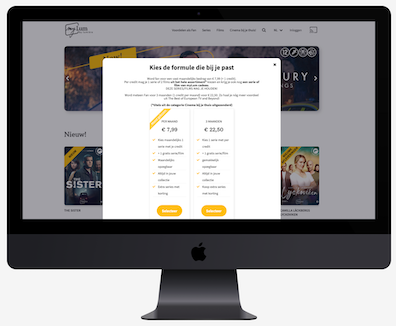
With AudiencePlayer you run subscriptions on your own video platform, in your own branding. You can offer monthly, quarterly or yearly plans and combine them with pay-per-view, rentals, credits and vouchers. You connect your own Mollie or Stripe account, so viewers pay with iDEAL, credit card or PayPal and the revenue goes straight to your bank account.
On AudiencePlayer, failed renewals are retried automatically for a few days, and viewers get an email with a payment button, so fewer subscribers are lost to an expired card. When a viewer cancels, the subscription simply stops renewing and access continues until the end of the paid period. If you want, you can also set a minimum term before cancelling is possible. Discount codes, free trials and automated emails are built in. See all monetisation options, or get in touch to find out which model suits your content.
Frequently Asked Questions
What is the biggest benefit of a subscription revenue model?
Predictable, recurring revenue. Each subscriber keeps paying until they cancel, so new customers add to your existing income instead of replacing last month’s sales.
What are the disadvantages of a subscription model?
You have to keep delivering new value, because subscribers who stop seeing it will cancel. Revenue per customer also starts lower than with a one-off sale, and you need reliable payment handling to avoid losing people to failed payments.
How do I calculate the value of a subscriber?
A simple estimate is the monthly price divided by your monthly churn rate. A subscriber paying €10 per month on a platform where 5% cancel each month is worth about €200 over their lifetime, before costs.
Should I offer monthly or yearly subscriptions?
Usually both. Monthly plans make it easy to start, while a discounted yearly plan improves cash flow and keeps subscribers longer.
Is a subscription model suitable for a small video platform?
Yes, if you publish content people return to, such as weekly classes or a growing series. For a small number of one-off titles or events, single purchases or tickets usually fit better, and you can combine both on one platform.