What Is TVOD?
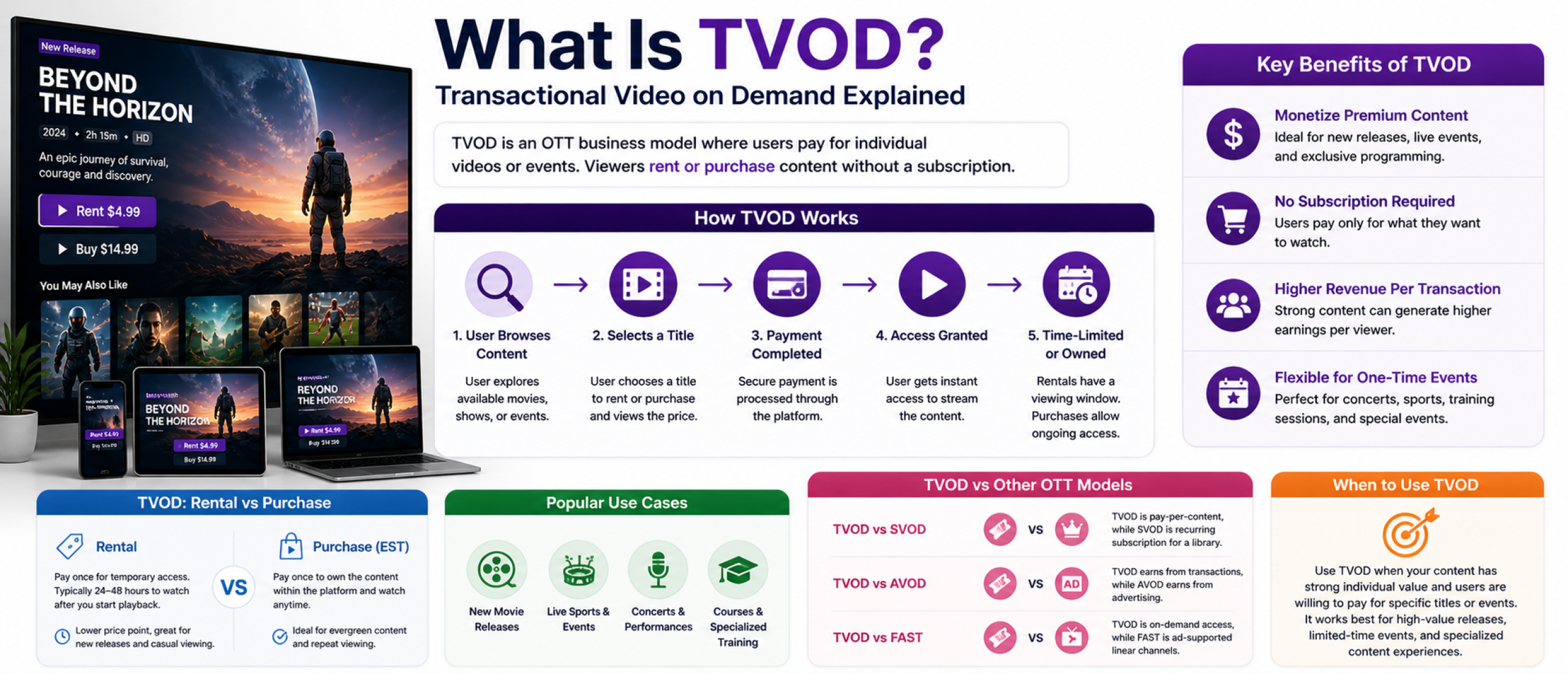
TVOD, or transactional video on demand, is an OTT business model where users pay for individual pieces of content rather than subscribing to an entire platform. Instead of recurring access, viewers make one-time payments to rent or purchase specific titles.
This model is commonly used for new movie releases, premium content, live events, and specialized programming where the value is tied to a specific viewing experience rather than an ongoing library.
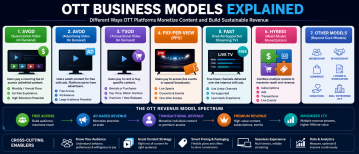
TVOD is one of the core OTT monetization strategies and is often used alongside subscriptions or ad-supported models. For a broader breakdown, see the OTT business models explained guide.
How TVOD Works
In a TVOD model, users browse available content and choose what they want to watch. Each title has its own price, and access is granted after payment. Depending on the offer, viewers may either rent the content for a limited time or purchase it for ongoing access.
Once a transaction is completed, the platform handles secure payment processing, content access control, and playback. Rentals often come with viewing windows, such as 24 or 48 hours after starting playback, while purchases typically allow repeated viewing within the platform.
Because each transaction is tied to a specific title or event, TVOD platforms focus heavily on content presentation, pricing strategy, and timing. The perceived value of the content plays a major role in conversion.
TVOD Rental vs Purchase
TVOD is usually divided into two main approaches: rentals and purchases. Rentals give users temporary access to content for a lower price, making them suitable for casual viewing or one-time experiences. Purchases, often referred to as electronic sell-through, allow users to access content repeatedly without time limits.
The choice between rental and purchase depends on the type of content and user intent. New releases and live events often perform well as rentals, while evergreen content, educational material, or fan-driven media may perform better as purchases.
Why Platforms Use TVOD
TVOD works best when content has clear, standalone value. Instead of relying on long-term engagement, platforms can monetize specific moments, releases, or experiences. This makes it particularly useful for premium content that audiences are willing to pay for upfront.
It also gives flexibility to users. Viewers are not locked into a subscription and can choose exactly what they want to watch. This can improve conversion for audiences who are hesitant to commit to recurring payments.
For content owners, TVOD can generate immediate revenue, especially around launches or live events. However, it often requires strong marketing, clear positioning, and well-timed releases to drive demand.
TVOD vs Other OTT Models
Compared to subscription models, TVOD does not rely on recurring payments. Instead, revenue is generated per transaction, which can make earnings less predictable but more tied to content performance. This makes it ideal for high-value releases rather than large content libraries.
Unlike ad-supported models, TVOD does not depend on audience scale or advertising demand. Revenue comes directly from users, which can result in higher earnings per viewer if the content is compelling enough.
TVOD is also different from FAST and linear streaming, as it focuses entirely on on-demand access without scheduled programming or continuous viewing experiences.
When to Use the TVOD Model
TVOD is most effective when your content has strong individual appeal. This includes new releases, exclusive content, live events, training programs, or specialized media where users are willing to pay for access.
It is especially useful for platforms that do not yet have a large content library or for businesses that want to monetize key moments rather than ongoing engagement. Many OTT platforms also use TVOD alongside subscriptions or ads to create a hybrid strategy, allowing them to capture both casual and high-intent viewers.