

On this page
Best IPTV Platforms and Providers for Streaming Businesses
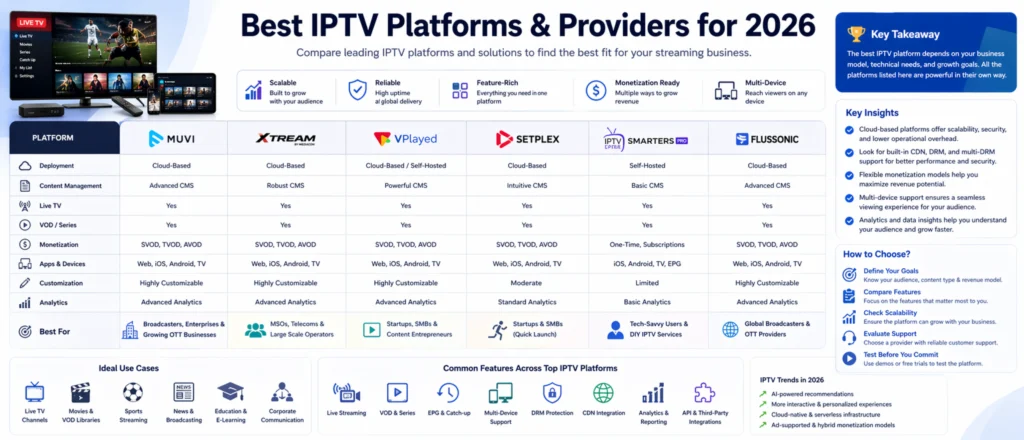
Choosing the best IPTV platform is not just a technical decision. It directly affects your ability to launch, scale, monetize content, and compete in a crowded streaming market. The right solution can accelerate growth, while the wrong one can create bottlenecks in performance, flexibility, and revenue.
This guide breaks down the different types of IPTV platforms, what features actually matter, and how to evaluate providers based on your specific business model.
New to the term? Start with our explanation of what IPTV is, or read how IPTV compares to OTT.
What Makes a Good IPTV Platform?
Not all IPTV providers are built the same. Some focus on rapid deployment with minimal setup, while others offer deeper control over infrastructure and customization.
A strong IPTV platform should deliver across four key areas: reliability, scalability, monetization, and user experience. If any one of these is weak, it will limit your ability to grow.
Reliability ensures consistent playback without buffering or downtime. Scalability determines whether your platform can handle traffic spikes and audience growth. Monetization flexibility allows you to generate revenue through subscriptions, ads, or transactions. User experience impacts retention and engagement across devices.
Types of IPTV Platforms Compared
Understanding the different categories of IPTV platforms is the first step in narrowing down your options.
Fully Managed IPTV Platforms
Fully managed platforms provide an all-in-one environment where hosting, encoding, delivery, and playback are handled for you. These solutions are designed for speed and simplicity.
The main advantage is fast time to market. You can launch a service quickly without building infrastructure or hiring a large technical team. However, this convenience often comes with limitations in customization and higher long-term costs.
These platforms are best suited for startups, content creators, and businesses that want to validate a concept before investing heavily in infrastructure.
AudiencePlayer is an example of this category. Hosting, encoding, CDN delivery, your own branded website, subscriptions and pay-per-view are handled in one platform, and you add modules such as live streaming, mobile apps and smart TV apps when you need them. Like most modern platforms, it delivers video over the open internet (OTT) rather than over a closed operator network.
Self-Hosted IPTV Solutions
Self-hosted IPTV platforms give you full control over your entire streaming stack. You manage encoding pipelines, storage, delivery, and playback systems directly.
This approach offers maximum flexibility and cost control at scale, but it requires significant technical expertise. You are responsible for performance, uptime, and scaling infrastructure as your audience grows.
Self-hosted solutions are typically used by larger media companies or businesses with in-house engineering teams.
Hybrid IPTV Platforms
Hybrid platforms combine managed services with custom infrastructure. For example, you might use a third-party CDN and encoding service while maintaining control over your applications and user experience.
This approach provides a balance between speed and flexibility. It allows you to scale efficiently while still customizing key parts of your platform.
Hybrid setups are often used by growing OTT providers transitioning from managed solutions to more advanced architectures.
Key Features to Compare Between IPTV Providers
When evaluating IPTV platforms, certain features have a direct impact on performance, growth, and revenue potential.
Video Delivery and Streaming Quality
The core function of any IPTV platform is delivering video reliably. Look for providers that support adaptive bitrate streaming, low-latency delivery for live content, and strong CDN integration.
Poor delivery performance will lead to buffering, increased churn, and negative user experience.
Multi-Device Support
Your audience expects access across smart TVs, mobile devices, web browsers, and streaming devices. A platform that limits device support will restrict your reach.
Ensure the provider supports consistent playback and UI experiences across all major platforms.
Content Management Capabilities
A robust content management system is essential for organizing video libraries, managing metadata, and controlling content availability.
Without strong CMS capabilities, scaling your content catalog becomes difficult and time-consuming.
Monetization Flexibility
The best IPTV platforms support multiple monetization models, including subscriptions, advertising, and pay-per-view.
This flexibility allows you to experiment with pricing strategies and adapt to changing market conditions.
Analytics and Insights
Access to detailed analytics is critical for understanding user behavior, optimizing content strategy, and improving retention.
Look for platforms that provide real-time data on engagement, playback performance, and revenue metrics.
Scalability and Infrastructure
A platform that performs well at small scale may struggle under heavy traffic. Evaluate how providers handle spikes in demand, global distribution, and long-term growth.
Scalability is especially important for live events and rapidly growing services.
Use Case-Based Platform Selection
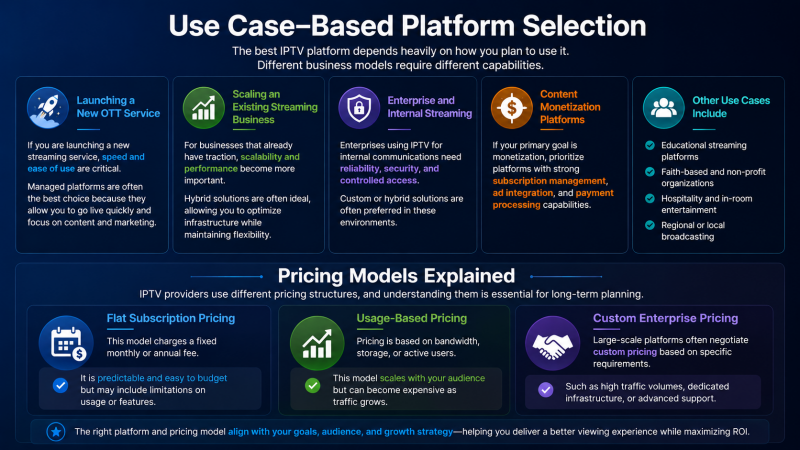
The best IPTV platform depends heavily on how you plan to use it. Different business models require different capabilities.
Launching a New OTT Service
If you are launching a new streaming service, speed and ease of use are critical. Managed platforms are often the best choice because they allow you to go live quickly and focus on content and marketing.
Scaling an Existing Streaming Business
For businesses that already have traction, scalability and performance become more important. Hybrid solutions are often ideal, allowing you to optimize infrastructure while maintaining flexibility.
Enterprise and Internal Streaming
Enterprises using IPTV for internal communications need reliability, security, and controlled access. Custom or hybrid solutions are often preferred in these environments.
Content Monetization Platforms
If your primary goal is monetization, prioritize platforms with strong subscription management, ad integration, and payment processing capabilities.
Pricing Models Explained
IPTV providers use different pricing structures, and understanding them is essential for long-term planning.
Flat Subscription Pricing
This model charges a fixed monthly or annual fee. It is predictable and easy to budget but may include limitations on usage or features.
Usage-Based Pricing
Pricing is based on bandwidth, storage, or active users. This model scales with your audience but can become expensive as traffic grows.
Custom Enterprise Pricing
Large-scale platforms often negotiate custom pricing based on specific requirements such as high traffic volumes, dedicated infrastructure, or advanced support.
How to Choose the Right IPTV Provider
Making the right choice requires aligning platform capabilities with your business goals.
Start by defining your target audience, content strategy, and monetization model. Then evaluate providers based on how well they support those requirements.
Consider long-term scalability, not just initial setup. A platform that is easy to launch but difficult to scale can create major challenges later.
Finally, test the platform from a user perspective. Playback quality, interface design, and overall experience will directly impact retention and growth.
Common Mistakes When Choosing an IPTV Platform
Many businesses make avoidable mistakes during the selection process.
Focusing only on price often leads to choosing platforms that lack critical features or scalability. Ignoring infrastructure limitations can result in performance issues as your audience grows.
Another common mistake is underestimating the importance of monetization flexibility. Choosing a platform with limited revenue options can restrict your ability to adapt and expand.
A careful evaluation process helps avoid these issues and ensures your platform supports long-term success.
Legal IPTV Platforms vs Illegal IPTV Subscriptions
Searching for the best IPTV providers also turns up cheap subscriptions that promise thousands of TV channels for a few euros a month. Most of these resell channels without permission from the rights holders. They are illegal, often unreliable, and can disappear overnight when they are taken down.
This guide is about platforms you use to distribute content you own or have licensed. A legitimate provider is clear about who it is, where your content and data are hosted and how you get paid. If a service cannot tell you that, look elsewhere.
Building a Competitive IPTV Service
The IPTV market is highly competitive, and technology alone is not enough. Success depends on combining the right platform with a strong content strategy, effective monetization, and a seamless user experience.
By selecting a platform that aligns with your goals and supports future growth, you position your business to compete more effectively and capture long-term value in the streaming market.
Want to see what a fully managed platform looks like in practice? Request a demo of AudiencePlayer.
Frequently Asked Questions
What is the best IPTV platform for a streaming business?
There is no single best platform: it depends on whether you need a fast launch, full control over infrastructure or a mix of both. Organisations without a development team usually do best with a fully managed platform, while large operators with engineering teams often choose self-hosted or hybrid setups.
Are IPTV subscriptions with thousands of channels legal?
Usually not. Services that resell TV channels without the rights holders’ permission are illegal, and in 2017 the Court of Justice of the EU ruled in the Filmspeler case that streaming from such sources is not covered by the exception for temporary copies. Legitimate platforms only distribute content their customers own or have licensed.
How do IPTV providers charge for their platform?
Most use flat subscription pricing, usage-based pricing (bandwidth, storage or active users) or custom enterprise pricing. Check how your costs grow with your audience, because streaming data increases with every extra viewer. On AudiencePlayer, storage, streaming data and encoding are matched to how much you publish and how much is watched.
Which devices should an IPTV platform support?
At a minimum a web player and apps for iOS and Android, and ideally smart TV apps and casting, because long-form video is often watched on the big screen. On AudiencePlayer you can add apps for iOS and Android, Samsung and LG smart TVs (Android TV in beta), and Chromecast and AirPlay.
Can I launch an IPTV service without my own technical team?
Yes. A fully managed platform takes care of hosting, encoding, delivery and apps, so you can focus on content and marketing. On AudiencePlayer you can also have the team set up the platform for you.