

On this page
Online fitness platforms have transformed how people access workouts, coaching, wellness programs, and fitness communities. Instead of relying solely on physical locations, fitness brands can now deliver content directly to members through web, mobile, smart TV, and connected devices.
Whether you’re a gym owner, personal trainer, fitness influencer, wellness brand, or sports organization, building an online fitness platform creates new opportunities to reach larger audiences and generate recurring revenue.
As demand for digital fitness continues to grow, many businesses are launching dedicated streaming platforms to offer on-demand workouts, live classes, training programs, and subscription memberships. For more insights into fitness streaming and digital wellness platforms, visit our Fitness & Health Streaming Hub.
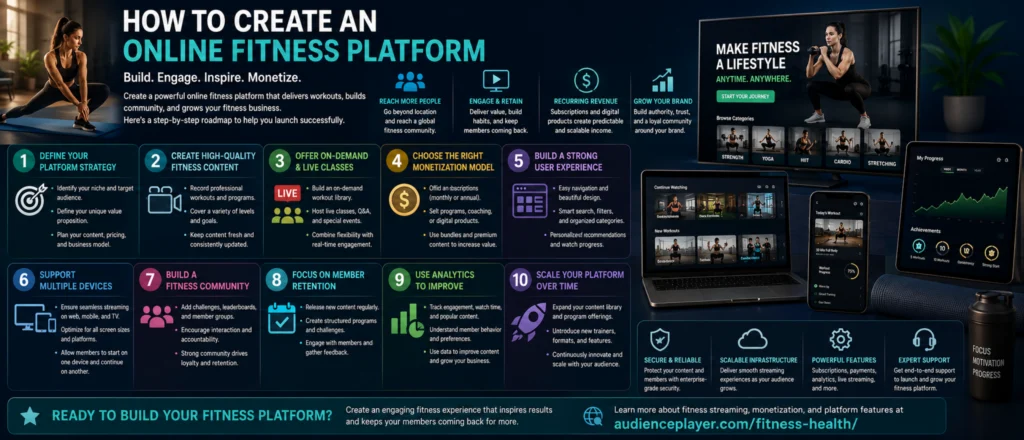
Define Your Fitness Platform Strategy
Before choosing technology or creating content, it’s important to define the purpose of your platform. Different fitness businesses serve different audiences and goals.
Some platforms focus on yoga and mindfulness, while others specialize in strength training, cycling, HIIT workouts, dance fitness, rehabilitation programs, nutrition coaching, or sports performance training.
Understanding your target audience helps shape your content strategy, pricing model, branding, and overall member experience.
Create High-Quality Fitness Content
Content is the foundation of every successful fitness platform. Members join because they want valuable workouts, expert coaching, and programs that help them achieve measurable results.
Most fitness platforms combine a library of on-demand content with regularly updated classes to keep members engaged. This may include beginner programs, advanced training plans, mobility sessions, nutrition content, and specialty courses.
Consistency is often more important than volume. A smaller library of high-quality content can outperform a large collection of poorly organized workouts.
Offer On-Demand and Live Classes
Many successful fitness businesses combine video-on-demand content with live streaming experiences.
On-demand workouts provide flexibility, allowing members to exercise whenever it suits their schedule. Live classes create engagement, accountability, and a stronger sense of community.
This hybrid approach helps fitness brands serve different user preferences while maximizing member retention.
On AudiencePlayer, live streaming is a module you can add: you connect OBS or a hardware encoder with an RTMP link and offer the class for free, with a ticket or as part of a subscription. Record the class locally if you want to add it to your on-demand library afterwards. Our guide to live streaming fitness classes walks you through the setup.
Choose the Right Monetization Model
Subscription memberships are the most common monetization strategy for online fitness platforms. Members pay monthly or annually for ongoing access to workout content and programs.
Some fitness businesses also sell individual programs, coaching packages, premium events, certifications, or digital products.
Hybrid monetization models are becoming increasingly popular, allowing platforms to combine subscriptions with one-time purchases or premium content offerings.
On AudiencePlayer you can combine monthly, quarterly or yearly subscriptions with single purchases, bundles, vouchers and free trials. Members pay with iDEAL, credit card, PayPal or other popular methods through your own Mollie or Stripe account, so the revenue goes straight to your bank account. For more on memberships, read creating a subscription fitness platform.
Build a Strong User Experience
The user experience plays a major role in retention and long-term platform growth. Members should be able to find workouts easily, track progress, and access content across multiple devices.
Fitness platforms often organize content by workout type, duration, difficulty level, trainer, or fitness goal.
A clean and intuitive experience encourages members to return regularly and consume more content over time.
Support Multiple Devices
Modern fitness audiences expect access across smartphones, tablets, web browsers, smart TVs, and connected TV devices.
Many users start workouts on one device and continue on another, making cross-device accessibility increasingly important.
Expanding beyond mobile and desktop can significantly increase engagement and viewing time.
On AudiencePlayer, every platform starts with your own website, and the player remembers where a member left off on any device. Native iOS and Android apps, smart TV apps for Samsung and LG (with Android TV in beta), and Chromecast and AirPlay are modules you can add, so members can follow a workout on the big screen.
Build a Fitness Community
Community is often one of the biggest differentiators between successful fitness platforms and simple video libraries.
Features such as challenges, member groups, progress tracking, live events, and trainer interaction help create stronger relationships between members and the platform.
A strong community can improve retention rates and increase long-term membership value.
Focus on Member Retention
Acquiring new members is important, but retaining existing members is often more valuable for sustainable growth.
Regular content releases, structured programs, seasonal challenges, and personalized recommendations help keep members engaged.
Fitness platforms that continuously deliver new value are more likely to maintain recurring subscription revenue.
Use Analytics to Improve Performance
Analytics provide valuable insight into how members interact with your content. Understanding which workouts are most popular, where users drop off, and which programs drive retention can help guide future decisions.
Data-driven content planning allows fitness businesses to focus resources on the formats and topics that generate the strongest engagement.
Over time, analytics become an important part of optimizing both content strategy and business performance. AudiencePlayer’s built-in statistics show what is watched, for how long and on which device, and you can send data to Google Analytics and Google Tag Manager for your campaigns.
Scale Your Platform Over Time
Most successful fitness streaming businesses start with a focused content offering and expand gradually. As the audience grows, new workout categories, trainers, live events, coaching services, and membership tiers can be introduced.
Scalable technology and a clear content strategy make it easier to support long-term growth without sacrificing user experience.
If you’re exploring opportunities in digital wellness, fitness subscriptions, and workout streaming, our Fitness & Health Streaming Hub covers additional strategies, trends, and platform insights for growing a successful fitness business online. Want to see what your own fitness platform could look like? Request a demo.
Frequently Asked Questions
How much content do I need to launch an online fitness platform?
You don’t need a huge library to start. A focused set of well-produced workouts or one complete program, plus a clear schedule for new releases, is enough to launch and learn what your members want.
Should I offer live classes, on-demand workouts or both?
Most fitness platforms do best with both. On-demand workouts give members flexibility, while live classes add accountability and community, and recordings of live classes can grow your on-demand library.
Can members follow my workouts on their TV?
Yes, if you add smart TV apps or casting. On AudiencePlayer, Samsung and LG apps, Android TV (in beta), Chromecast and AirPlay are optional modules on top of your website.
How do members pay for an online fitness platform?
Usually through a recurring subscription, sometimes combined with one-off program purchases. On AudiencePlayer you connect your own Mollie or Stripe account, and in your mobile apps members pay through the App Store and Google Play.
Do I need my own app to get started?
No. Many fitness platforms launch with a website that works on any device and add native iOS and Android apps once their audience grows. Apps do add extras such as push notifications and offline viewing.