


On this page
OTT TV is television and video delivered over the open internet, straight to the viewer, without a cable, satellite or telecom operator in between. OTT stands for “over the top”: the service runs on top of whatever internet connection the viewer already has. Netflix, Disney+ and YouTube are the best-known examples, but OTT is not just for big media companies. Fitness studios, film organisations, sports clubs, churches and educators run their own OTT platforms too. In this article we explain what OTT TV is, how it differs from traditional TV, how OTT services earn money and what you need to start one for your own organisation.
What OTT TV means
With traditional TV, a broadcaster or TV provider decides what is on and when, and the signal reaches you through a cable, satellite dish or set-top box. With OTT, the content provider streams video directly to an app or website. The viewer only needs an internet connection and a device: a laptop, phone, tablet, smart TV or streaming stick.
For viewers that means control. They choose what to watch and when, pause and continue on another device, and pick content that matches their interests instead of a fixed schedule. OTT has become the normal way to watch video, and viewers now expect the same experience from every service: apps on all their screens, fast start-up, sharp picture and easy payment.
OTT versus traditional TV and IPTV
OTT is often confused with IPTV, because both use internet technology. The difference is in who controls the network:
- Traditional TV (cable, satellite, terrestrial) broadcasts a fixed schedule of channels through the provider’s own infrastructure.
- IPTV is TV from a telecom or cable operator, delivered over its own managed network to its own set-top box or app. You need a subscription with that provider.
- OTT works over any internet connection, from any provider, on any device. The content provider deals with the viewer directly.
Want the full comparison? Read IPTV vs OTT: key differences, pros and cons.
How OTT services earn money
Where traditional TV relies mainly on advertising and TV subscriptions, OTT services can choose from several revenue models, and often combine them:
- SVOD (subscription video on demand): viewers pay a monthly or yearly fee for access to the whole library, as with Netflix.
- TVOD (transactional video on demand): viewers buy or rent a single film, series or event.
- AVOD and FAST: free viewing paid for by advertising, either on demand or as linear channels with a schedule.
- Credits and hybrid models: viewers buy credits to spend on content of their choice, or a free tier leads to paid content.
Which model works best depends on your audience and your content. A library of workouts suits a subscription, a film premiere or a live event suits a ticket. The article OTT business models explained covers each option in more detail.
Can your organisation use OTT?
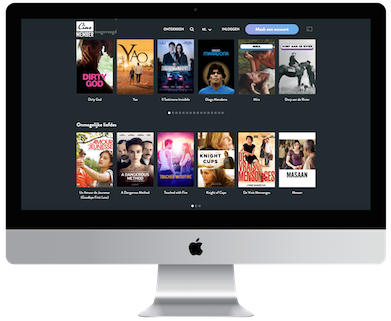
Yes, and that is what has changed most since OTT became mainstream. You don’t need to be a broadcaster. More and more organisations run a branded OTT service for a specific audience: yoga and fitness studios with classes at home, film organisations with their own catalogue, sports clubs with matches and highlights, coaches and educators with courses, and churches with services live and on demand.
Running your own OTT platform has clear advantages over publishing on YouTube or social media alone:
- Independence: no algorithm decides who sees your content, and a platform changing its rules can’t take away your income.
- Your own pricing: you choose the revenue model and the price, and the revenue goes to your own account.
- A direct relationship: you know who your viewers are and what they watch, so you can improve your offer and stay in touch through email and push notifications.
- Your brand: your domain, logo and colours, without ads or recommendations from other channels.
What you need for your own OTT service
An OTT service has more moving parts than a video page on a website. At the very least you need video hosting and encoding into multiple qualities, adaptive streaming through a content delivery network, a website where viewers sign up and pay, payment processing and subscription management, and protection against illegal downloads. As you grow, you add mobile apps, smart TV apps, casting to the TV, live streaming and marketing tools. Building all of that yourself takes a development team. A white-label OTT platform gives you the same building blocks ready to use, under your own brand.
Your own OTT platform with AudiencePlayer
AudiencePlayer is a complete OTT platform for organisations that want their own streaming service without building the technology themselves. The basis is always your own website in your own branding, built with the website builder, with video on demand and audio, subscriptions and single purchases, your own domain, marketing tools and statistics. Viewers pay with iDEAL, credit card or PayPal through your own Mollie or Stripe account.
From there you add what your audience needs: mobile apps for iOS and Android, smart TV apps for Samsung and LG (and Android TV, in beta), Chromecast and AirPlay, live streaming and DRM protection. You also choose where your platform runs: on sovereign European infrastructure or on globally scalable cloud infrastructure. Want to see what your own OTT service could look like? Request a demo.
Frequently Asked Questions
What does OTT stand for?
OTT stands for “over the top”. It means video is delivered over the open internet, on top of the viewer’s existing connection, instead of through a cable, satellite or telecom operator.
Is Netflix an OTT service?
Yes. Netflix streams directly to viewers over the internet, on any device and with any internet provider, which makes it a typical OTT service. Disney+, YouTube and the streaming apps of broadcasters are OTT as well.
What is the difference between OTT and IPTV?
IPTV is delivered by a telecom or cable operator over its own managed network, usually to its own set-top box. OTT works over any internet connection, and the content provider deals with the viewer directly.
How do OTT platforms make money?
Mainly through subscriptions (SVOD), single purchases or rentals (TVOD), advertising (AVOD and FAST) or a combination. Smaller, specialised OTT services usually rely on subscriptions and paid events rather than advertising.
Do I need my own apps to start an OTT service?
No. Many OTT services start with a streaming website that works in every browser and add mobile and smart TV apps once the audience grows. On AudiencePlayer, apps, Chromecast and AirPlay are modules you can add to your platform at any time.