

On this page
What Are FAST Channels?
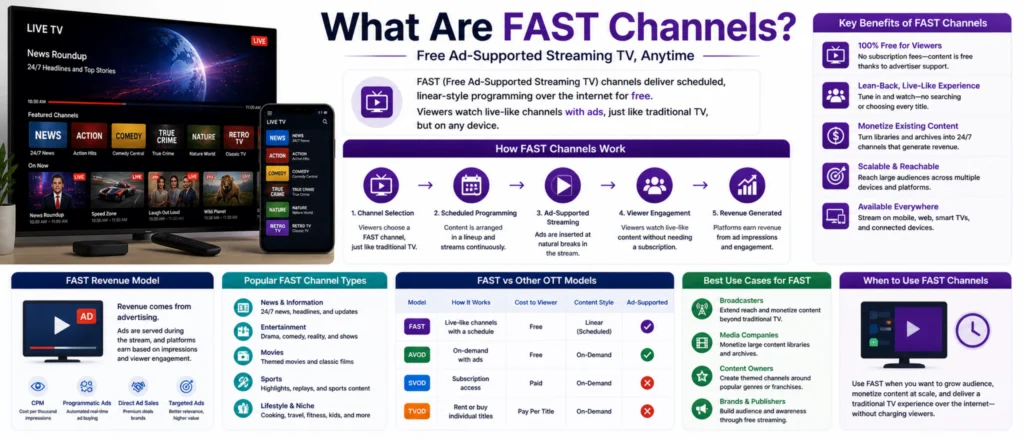
FAST channels, or free ad-supported streaming TV channels, are a type of OTT streaming model that delivers scheduled, linear-style content over the internet. Instead of selecting individual videos on demand, viewers tune into a continuous stream of programming, similar to traditional television, but without a subscription fee.
These channels are supported by advertising, allowing users to watch content for free while the platform generates revenue from ads. FAST has become a major part of modern streaming strategies, especially for media companies with large content libraries.
FAST is one of the core OTT monetization approaches and is often used alongside on-demand and subscription models. For a broader view, see the OTT business models explained guide.
How FAST Channels Work
FAST channels stream content in a continuous, scheduled format. Instead of browsing a catalog, users select a channel and start watching whatever is currently playing. Programming is arranged in advance, creating a lean-back viewing experience similar to traditional broadcast TV.
Content is delivered over OTT infrastructure and monetized through ad insertion. Ads are placed at natural breaks within the stream, and revenue is generated based on impressions and viewer engagement.
Many FAST platforms also include an electronic program guide, allowing viewers to see what is currently playing and what is coming next across different channels.
What Makes FAST Different
Unlike video on demand, FAST channels do not require users to choose specific titles. The experience is passive, making it easier for viewers to start watching without decision fatigue. This creates a more traditional TV-like experience, but delivered through streaming apps on connected devices.
Compared to subscription streaming, FAST removes the payment barrier entirely. Users can access content instantly, which helps platforms grow audience reach quickly. At the same time, it differs from standard AVOD because the content is organized into channels rather than individual on-demand videos.
Why FAST Channels Are Growing
FAST channels have gained traction as audiences look for free alternatives to paid streaming services. With subscription fatigue increasing, many viewers are returning to lean-back experiences that do not require constant searching or multiple subscriptions.
For content owners, FAST offers a way to monetize existing libraries. Older shows, archived content, niche programming, and themed collections can be repackaged into channels and distributed across multiple platforms.
This model also allows for continuous monetization. Instead of relying on one-time transactions or recurring subscriptions, FAST generates ongoing revenue as long as viewers continue watching and ads are served.
How FAST Channels Make Money
Revenue in FAST channels comes from advertising. Ads are inserted into the stream in a similar way to traditional TV, but with the added advantage of digital targeting and measurement.
Platforms can sell ad inventory programmatically or through direct deals with advertisers. The value of ad placements depends on audience size, viewer engagement, content type, and targeting capabilities.
Because FAST channels run continuously, they create consistent opportunities for ad impressions, making them an attractive model for both publishers and advertisers.
Common FAST Channel Use Cases
FAST channels are often built around themes or content categories. This might include genres like crime, comedy, sports highlights, documentaries, or reality TV. Some channels focus on a single show or franchise, running episodes in a loop to attract dedicated fans.
Broadcasters use FAST to extend the life of their content beyond traditional distribution. Media companies use it to reach new audiences globally. Niche platforms use it to create curated experiences without requiring large-scale on-demand catalogs.
When to Use FAST Channels
FAST works best when you have a substantial content library that can be organized into continuous programming. It is particularly effective for archive content, themed collections, and content that performs well in a passive viewing environment.
If your goal is to expand reach, monetize existing assets, and create a free entry point into your platform, FAST can be a strong addition to your OTT strategy. Many platforms combine FAST with on-demand content and subscriptions to create a more complete offering.
Keep in mind that FAST depends on scale. Ad revenue per viewer is low, so the model mainly pays off for libraries large enough to fill channels around the clock and audiences large enough to attract advertisers.
FAST and AudiencePlayer
AudiencePlayer is not a FAST platform: it does not offer ad insertion or ad-supported linear channels. It is built for direct revenue from your own audience, through subscriptions, pay-per-view, rentals and vouchers, with your platform fully in your own branding and without ads from others.
If you want a free entry point without ads, you can give visitors free accounts with access to selected content and turn them into paying viewers later. For scheduled broadcasts such as events, matches or services, live streaming can be added to your platform, free or paid, with the recordings offered on demand afterwards.
Frequently Asked Questions
What is the difference between FAST and AVOD?
Both are free for viewers and funded by ads. AVOD offers individual videos on demand, while FAST organizes content into linear channels that play continuously on a schedule.
Do viewers need an account or subscription to watch FAST channels?
Usually not. FAST channels are free to watch, and many services let viewers start without signing up, which keeps the barrier to entry low.
How do FAST channels make money?
Through advertising. Ads are inserted at breaks in the stream and sold programmatically or through direct deals, with revenue based on impressions and audience targeting.
Is FAST the same as live TV?
Not quite. FAST channels feel like live TV because they play on a schedule, but the programming usually consists of pre-recorded content rather than live broadcasts.
Does AudiencePlayer support FAST channels?
No. AudiencePlayer does not offer ad insertion or FAST channels. It focuses on subscriptions, pay-per-view, rentals and free access, combined with live streaming as an optional module.