

On this page
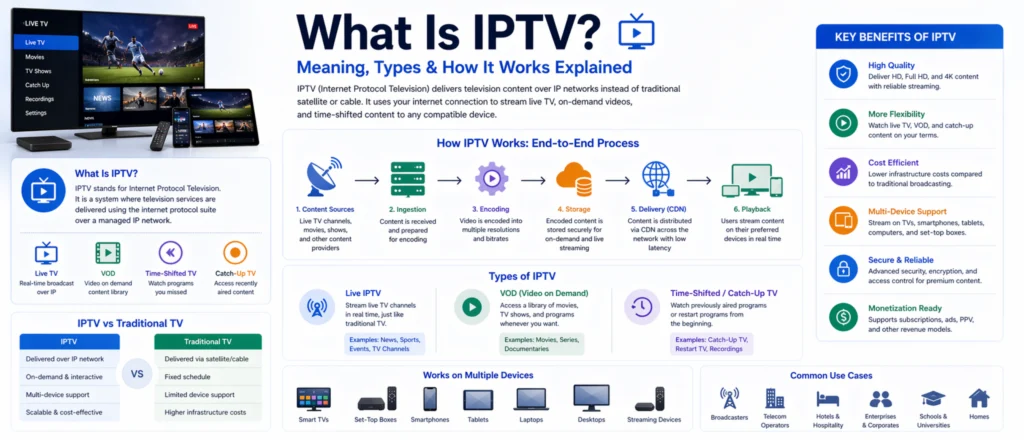
IPTV stands for Internet Protocol Television. In simple terms, IPTV is a way of delivering TV channels, live broadcasts, and on-demand video over IP networks, such as a broadband internet connection or a telecom operator’s own network, instead of through traditional cable, satellite or antenna broadcasting.
Rather than sending television content through fixed broadcast signals, IPTV uses IP-based networks to stream video directly to supported devices such as smart TVs, smartphones, tablets, laptops, streaming boxes, and set-top boxes.
For viewers, that means more flexibility in how content is watched. For media businesses, broadcasters, and OTT providers, IPTV creates a more scalable and controllable way to distribute video content digitally.
IPTV Meaning Explained
The term “IPTV” is made up of three parts:
- IP = Internet Protocol, the system used to deliver data over networks
- TV = television or video content
- IPTV = television delivered using IP networks
Although people often assume IPTV simply means “TV over the internet,” the concept is slightly broader. IPTV can be delivered over managed private networks, broadband infrastructure, or other IP-based environments, depending on the provider’s setup.
At its core, IPTV refers to video content that is transmitted using internet protocol rather than legacy broadcast methods.
How IPTV Works at a High Level
IPTV works by taking video content, converting it into digital data packets, and delivering those packets over an IP network to an end user’s device.
Instead of broadcasting every channel to every household at the same time, IPTV can deliver content more selectively. A user requests a live stream, movie, or TV show, and the system sends that content to the device in real time or on demand.
This model supports a wide range of viewing experiences, including live television, catch-up TV, and video on demand. For a step-by-step look at the technology, see how IPTV works: end-to-end architecture.
IPTV vs OTT vs Cable
IPTV, OTT, and cable are often mentioned together, but they are not the same thing.
What Is the Difference Between IPTV and OTT?
OTT stands for over-the-top streaming. OTT services deliver video over the public internet directly to users, usually through apps or web platforms. Examples include subscription streaming services, ad-supported streaming platforms, and branded video apps.
IPTV also uses IP-based delivery, but in the strict sense it refers to a television service that a telecom operator or internet provider delivers over its own managed network, usually to a set-top box. Because the operator controls the network, it can guarantee picture quality. These services typically include live channels, channel guides and scheduled programming.
In practical terms:
- OTT is often app-first and internet-first
- IPTV is often channel-first, service-based, and may run on managed infrastructure
- Cable relies on legacy broadcast distribution over coaxial networks
There can be overlap in real-world use, which is why some providers use both IPTV and OTT technologies together. For a detailed comparison, read IPTV vs OTT: key differences.
Types of IPTV Services
Most IPTV services fall into three main categories. Understanding these types helps explain why IPTV is widely used across modern video platforms.
1. Live IPTV
Live IPTV refers to television content streamed in real time, similar to traditional broadcast TV. This includes live news, sports, entertainment channels, and event programming.
Users tune in while the content is being aired, often through a channel guide or electronic program guide interface.
2. Video on Demand (VOD)
VOD allows users to choose and watch content whenever they want. Instead of following a fixed broadcast schedule, viewers can browse a library and start playback instantly.
This is one of the most popular IPTV experiences because it gives users more control over what they watch and when they watch it.
3. Time-Shifted TV
Time-shifted IPTV allows viewers to access content after its original broadcast window. This can include catch-up TV, replay TV, or start-over functionality.
It is particularly useful for users who miss a scheduled broadcast but still want access without waiting for the content to appear in a full VOD library.
Notable Benefits of IPTV
IPTV has become increasingly important because it offers advantages for both viewers and service providers.
Benefits for Viewers
- Access content across multiple devices
- Watch live TV and on-demand video in one environment
- Enjoy more flexible viewing schedules
- Get interactive features such as pause, replay, and catch-up viewing
- Experience a more personalized content journey
Benefits for Providers
- Launch and scale digital TV services more efficiently
- Support live, VOD, and time-shifted experiences from one platform strategy
- Reach users across smart TVs, mobile apps, web, and streaming devices
- Improve control over delivery, monetization, and user experience
- Create opportunities for subscription, advertising, and transactional revenue models
What Devices Can IPTV Run On?
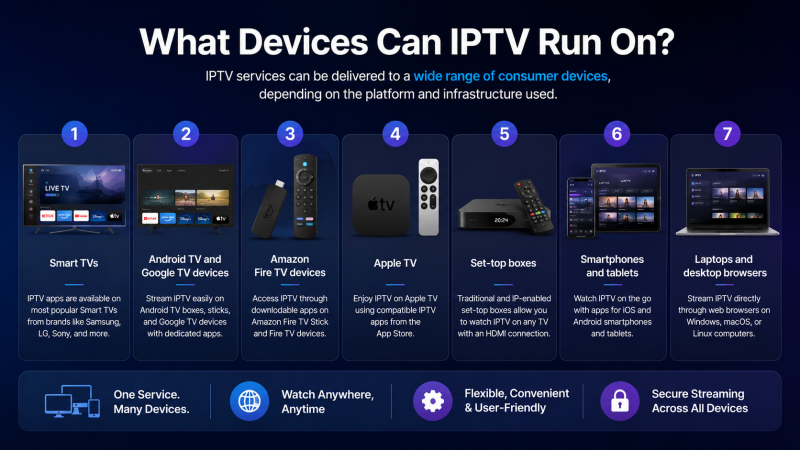
IPTV services can be delivered to a wide range of consumer devices, depending on the platform and infrastructure used.
- Smart TVs
- Android TV and Google TV devices
- Amazon Fire TV devices
- Apple TV
- Set-top boxes
- Smartphones and tablets
- Laptops and desktop browsers
Why IPTV Matters Today
Consumer expectations have changed. Audiences now expect video services to be available on multiple devices, with better control over playback, content discovery, and personalization. IPTV supports that shift by combining digital delivery with a familiar television experience.
For businesses entering the streaming market, IPTV can also serve as a bridge between traditional broadcast-style services and more advanced digital video platforms.
Is IPTV the Same as Streaming?
IPTV is a form of streaming, but not all streaming is IPTV.
Streaming is the broader category. It includes everything from short-form social video to subscription entertainment apps and live sports platforms. IPTV is more specific. It generally refers to television-like video delivery over IP networks, often with structured channels, scheduled programming, and service-level management.
That is why IPTV and streaming are related, but not interchangeable terms.
Frequently Asked Questions
Is IPTV legal?
IPTV as a technology is legal and is used by telecom operators, broadcasters and streaming services. What is illegal is offering or watching channels without the rights holders’ permission, as many cheap “IPTV subscriptions” with thousands of channels do. In 2017 the Court of Justice of the EU ruled in the Filmspeler case that streaming from such unlawful sources is not covered by the exception for temporary copies.
What do you need to watch IPTV?
You need a stable internet or network connection and a supported device: a set-top box from your provider, a smart TV app, a streaming device, a phone or tablet, or a web browser. Which devices work depends on the service.
Is IPTV the same as OTT?
Not quite. Classic IPTV runs over a provider’s managed network with guaranteed quality, while OTT services reach viewers over the open internet through apps and websites. In everyday language the terms are often mixed up, because both deliver video over IP.
Does IPTV need a fast internet connection?
A stable connection matters more than raw speed. Most modern services use adaptive bitrate streaming, which lowers the quality when the connection drops instead of stopping playback. HD and especially 4K do need more bandwidth than standard definition.
Can an organisation launch its own TV-style video service?
Yes, and most organisations do it as an OTT service rather than building a managed IPTV network. With AudiencePlayer you can offer livestreams and video on demand on your own website, with optional apps for mobile and smart TV, in your own branding and with your own revenue model.