Upload Speed Requirements for OTT Platforms
Upload speed is one of the most important technical requirements for OTT platforms. Every video uploaded, livestream broadcast, sports feed, movie release, or content update relies on sufficient upload bandwidth to move video content into streaming infrastructure.
Unlike viewers, who primarily depend on download speed to watch content, OTT operators depend on upload speed to ingest, publish, and distribute video assets efficiently.
The amount of upload bandwidth required depends on factors such as video resolution, bitrate, content volume, live streaming requirements, transcoding workflows, and platform scale.
Why Upload Speed Matters for OTT Platforms
Every OTT platform has an ingestion workflow where content is transferred from creators, broadcasters, production teams, or studios into the platform's infrastructure.
If upload bandwidth is limited, content publishing becomes slower and livestream reliability can suffer. This can delay content availability, increase operational inefficiencies, and create poor viewing experiences during live events.
As video libraries grow, upload performance becomes increasingly important for maintaining scalable content operations.
Upload Speed for Video-on-Demand Platforms
VOD platforms regularly upload movies, episodes, trailers, promotional content, and short-form videos. While these uploads are not time-sensitive like livestreams, large media files can quickly consume available bandwidth.
A single HD video file may be several gigabytes in size, while 4K content can be significantly larger. Faster upload speeds reduce publishing times and improve operational efficiency.
For OTT businesses managing large content catalogs, upload performance directly affects how quickly new content becomes available to viewers.
Upload Speed for Live Streaming
Live streaming places much higher demands on upload bandwidth because video must be transmitted continuously in real time.
Unlike VOD uploads, livestreams cannot pause and resume without affecting viewers. Stable upload performance is critical for maintaining video quality, reducing latency, and preventing dropped frames.
Sports streaming, live events, conferences, and premium broadcasts typically require higher upload capacity than standard VOD publishing workflows.
How Resolution Affects Upload Requirements
Higher video resolutions require more bandwidth because larger amounts of video data must be transmitted.
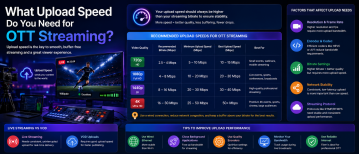
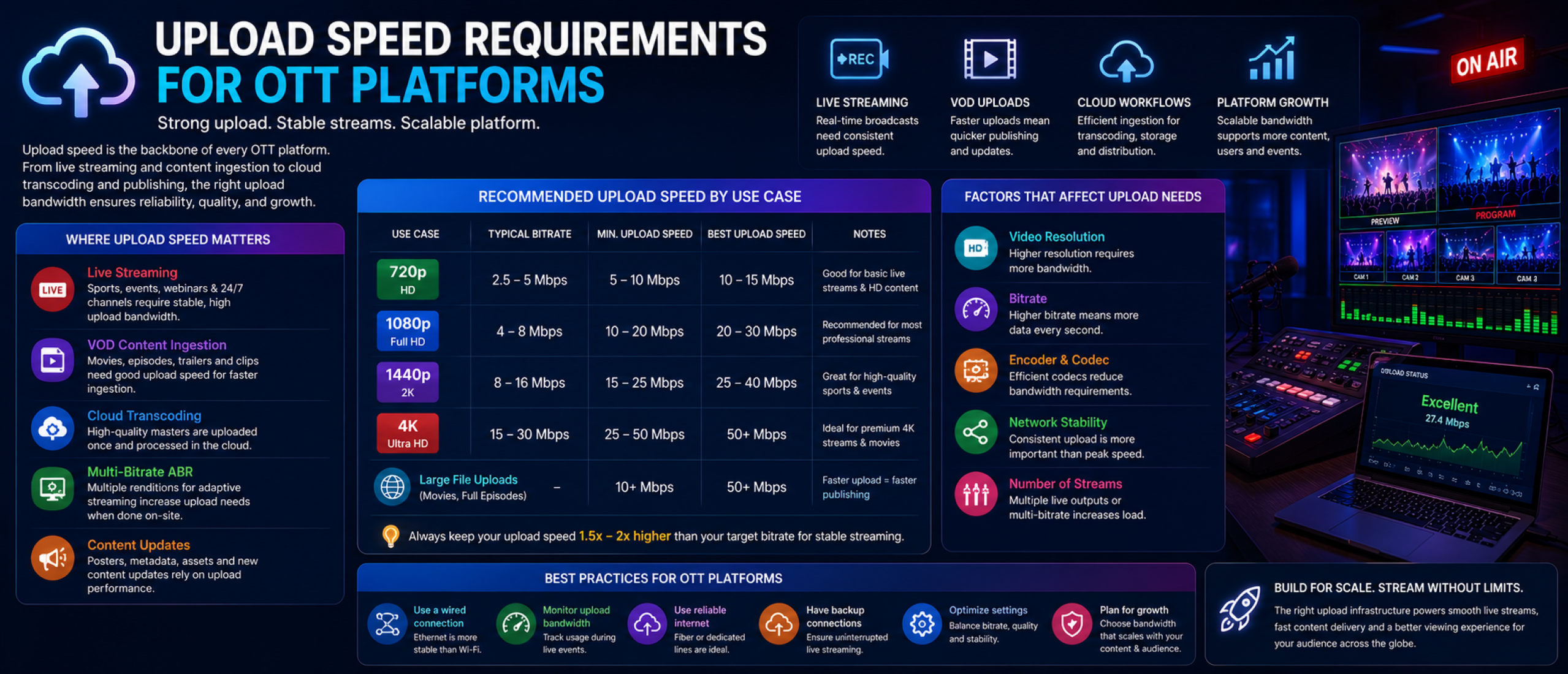
720p content typically requires relatively modest upload speeds, while 1080p streaming demands significantly more capacity. Professional 4K workflows can require upload speeds several times higher than HD content.
As OTT platforms move toward higher-quality viewing experiences, upload infrastructure must scale accordingly.
Bitrate and Upload Bandwidth
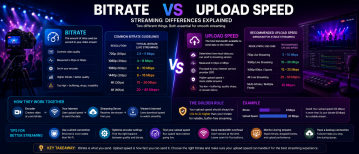
Bitrate determines how much video data is transmitted every second. Upload speed determines whether that bitrate can be delivered reliably.
OTT operators should maintain bandwidth overhead above the target bitrate to account for network fluctuations and maintain stream stability.
A common recommendation is to keep available upload speed at least 1.5 to 2 times higher than the outgoing bitrate for live streaming applications.
Cloud Transcoding and Upload Requirements
Many OTT platforms use cloud transcoding services to generate multiple video renditions for adaptive bitrate streaming.
In these workflows, content is uploaded once to cloud infrastructure, which then creates additional streaming formats automatically.
This reduces local upload requirements compared to workflows that generate and upload multiple renditions from on-premise infrastructure.
Upload Speed for Adaptive Bitrate Streaming
Adaptive bitrate streaming improves viewer experience by delivering different video qualities based on device capabilities and network conditions.
If multiple bitrate versions are generated locally, upload requirements increase because several streams may need to be transmitted simultaneously.
Cloud-based workflows can simplify this process by creating adaptive renditions after the initial upload.
Bandwidth Planning for Growing OTT Platforms
As OTT platforms expand, upload requirements often grow alongside content libraries, livestream operations, and audience expectations.
Businesses should plan for future bandwidth demands rather than only current needs. New content formats, higher resolutions, and increased production volume can quickly consume available upload capacity.
Scalable infrastructure helps avoid bottlenecks as streaming operations become more complex.
Common Problems Caused by Limited Upload Speed
Insufficient upload bandwidth can create slow content publishing, livestream buffering, increased latency, dropped frames, and failed broadcasts.
Large file uploads may take significantly longer than expected, delaying content availability and operational workflows.
For live OTT services, upload bottlenecks can directly affect viewer satisfaction and platform reliability.
Best Internet Connections for OTT Operations
Fiber internet is typically the preferred option for OTT platforms because it offers higher upload speeds, lower latency, and more consistent performance.
Cable internet may support smaller OTT operations but often provides limited upload capacity compared to fiber connections.
Professional broadcasters frequently use dedicated network connections, redundant internet providers, and failover systems to maintain uninterrupted streaming operations.
Building an OTT Platform for Scale
Upload speed should be viewed as part of a broader OTT infrastructure strategy rather than a standalone metric.
Successful streaming platforms combine sufficient upload bandwidth with efficient encoding, cloud processing, CDN delivery, and scalable storage systems.
As content libraries, livestreams, and audience demand continue to grow, strong upload infrastructure becomes essential for maintaining reliable OTT performance and supporting long-term platform growth.