How Upload Speed Affects Video Quality
Upload speed has a direct impact on video quality when streaming content online. Whether you're broadcasting a live event, running an OTT platform, hosting webinars, or streaming sports, insufficient upload bandwidth can reduce visual quality and create playback issues for viewers.
While video quality is often associated with resolution and bitrate, those settings can only perform as intended if enough upload bandwidth is available to support them.
A fast and stable upload connection helps deliver smoother streams, higher-quality video, lower latency, and a better overall viewing experience.
Why Upload Speed Matters
Every live stream sends a continuous flow of video data from an encoder to a streaming server. Upload speed determines how quickly that data can leave your network and reach the delivery infrastructure.
If upload bandwidth is too low, the stream may struggle to maintain the selected bitrate. This often forces the encoder to reduce quality or causes interruptions that viewers can immediately notice.
For OTT platforms, upload performance is one of the key factors that influences stream reliability and content quality.
The Connection Between Upload Speed and Bitrate
Bitrate controls how much video data is transmitted every second. Higher bitrates generally produce better image quality because more visual detail can be preserved.
However, higher bitrates also require more upload bandwidth. If the available upload speed cannot support the chosen bitrate, stream quality often suffers.
This is why upload speed and bitrate should always be planned together rather than treated as separate settings.
What Happens When Upload Speed Is Too Low?
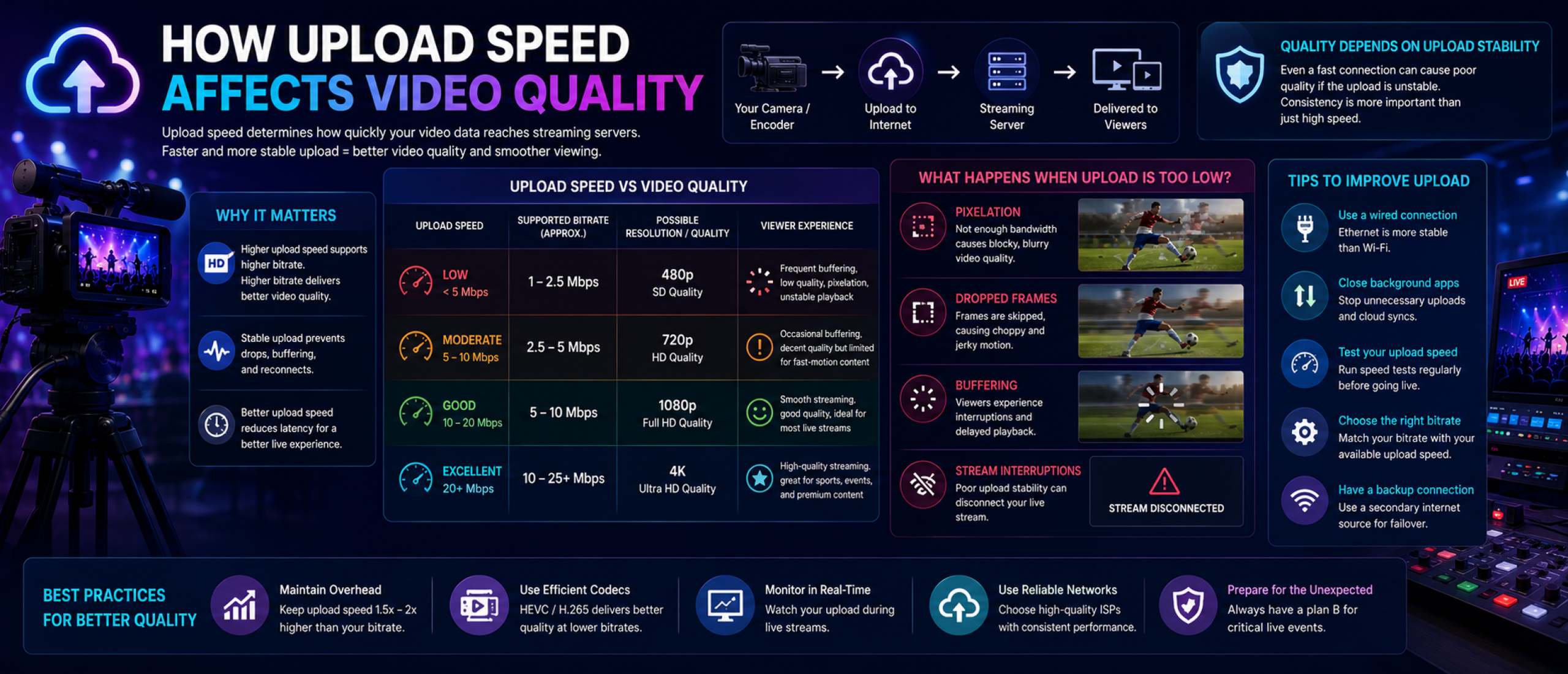
One of the most common symptoms of insufficient upload speed is video compression artifacts. These can appear as blocky images, blurry scenes, reduced detail, or pixelation during motion.
Streams may also experience dropped frames, where portions of the video are skipped because the encoder cannot transmit data quickly enough.
In more severe cases, viewers may encounter buffering, stream interruptions, or complete broadcast failures.
How Upload Speed Impacts Live Streaming
Live streaming is particularly sensitive to upload performance because content is delivered in real time.
Unlike video-on-demand uploads, live streams cannot pause to recover from network issues. If bandwidth becomes unstable, viewers may immediately notice lower quality, increased latency, or playback interruptions.
This makes upload stability just as important as raw upload speed for professional live broadcasts.
Video Quality at Different Upload Speeds
Lower upload speeds typically limit streaming quality to lower resolutions and bitrates. This may be sufficient for basic broadcasts but can struggle with fast-moving content.
Moderate upload speeds generally support reliable HD streaming and smoother viewer experiences.
Higher upload speeds allow broadcasters to deliver premium-quality streams, including high-bitrate 1080p and 4K content with greater consistency.
The exact requirements depend on resolution, frame rate, codec efficiency, and production complexity.
How Upload Speed Affects Sports and Fast-Motion Content
Sports, gaming, concerts, and live events often require more bandwidth than static presentations or talking-head videos.
Fast-moving scenes generate more visual information, which increases bitrate requirements if quality is to be maintained.
When upload bandwidth is limited, motion-heavy content often shows quality degradation first because compression systems have less data available to work with.
Upload Speed and Streaming Latency
Upload speed can also affect latency, especially during live broadcasts.
If the encoder struggles to transmit video data quickly enough, delays can build throughout the streaming pipeline. This can increase the time between the live event and what viewers actually see.
Low-latency streaming workflows benefit from strong upload performance and stable network conditions.
Why Stability Matters More Than Peak Speed
Many broadcasters focus only on maximum upload speed, but consistency is often more important.
A connection that occasionally drops below the required bitrate can create noticeable quality problems even if average speeds appear sufficient.
Professional OTT workflows typically include bandwidth overhead to absorb temporary fluctuations and maintain stable delivery.
Improving Video Quality Through Better Upload Performance
Using wired ethernet connections instead of Wi-Fi can significantly improve upload stability.
Reducing network congestion, closing background applications, and using modern video codecs can also help maximize available bandwidth.
Many professional broadcasters monitor upload performance continuously during live events to identify potential problems before viewers notice them.
Why Upload Speed Matters for OTT Platforms
OTT platforms depend on reliable upload infrastructure for livestreams, content ingestion, cloud transcoding, and multi-device video delivery.
As audiences expect higher-quality viewing experiences, upload bandwidth becomes increasingly important for maintaining competitive streaming quality.
Strong upload performance helps OTT businesses deliver better video quality, reduce technical issues, and create a more reliable viewing experience across every device.