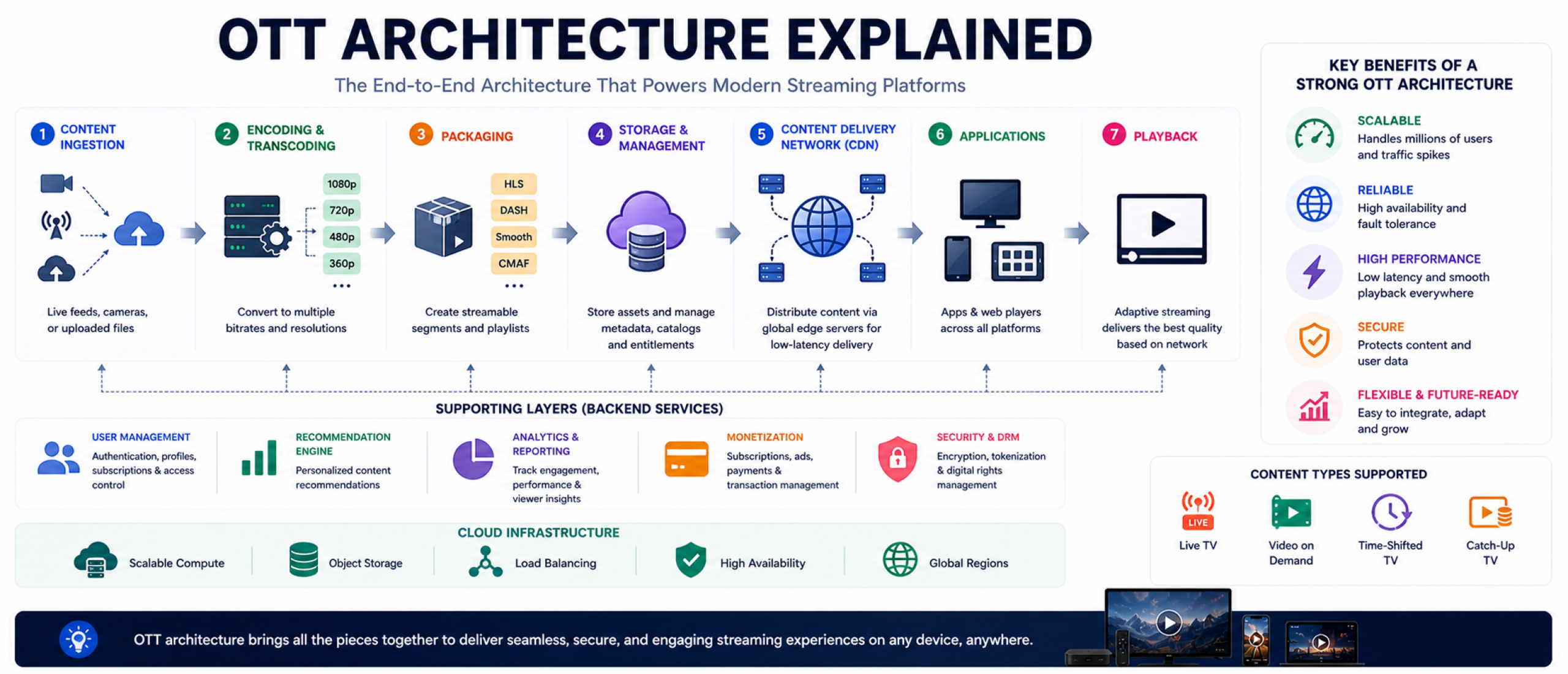
OTT Architecture Explained
OTT architecture refers to the complete system that powers video streaming platforms, from content ingestion to playback on user devices. It combines multiple components such as encoding pipelines, cloud infrastructure, content delivery networks, and applications to deliver video efficiently at scale.
Understanding OTT architecture is essential for building a reliable, scalable, and high-performing streaming platform.
What Is OTT Architecture?
OTT architecture is the technical framework that enables video content to be delivered over the public internet. It includes backend services, delivery infrastructure, and frontend applications that work together to provide a seamless streaming experience.
Unlike traditional broadcast systems, OTT platforms are built using distributed, cloud-based systems designed to handle large audiences across multiple devices and regions.
Core Components of OTT Architecture
An OTT platform is made up of several interconnected components, each responsible for a specific part of the streaming process.
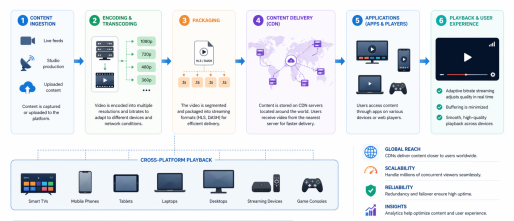
Content Ingestion Layer
This is where video content enters the system. Content can come from live feeds, studio productions, or uploaded media files.
The ingestion layer prepares raw content for processing, ensuring it is compatible with the rest of the streaming pipeline.
Encoding and Transcoding Layer
Once ingested, video is encoded into digital formats and transcoded into multiple resolutions and bitrates. This enables adaptive streaming, allowing users to receive the best possible quality based on their connection.
This layer is critical for optimizing video delivery across different devices and network conditions.
Packaging Layer
Packaging converts encoded video into streaming formats that can be delivered over HTTP. It breaks video into small segments and organizes them into playlists.
This step ensures compatibility with modern video players and enables smooth switching between quality levels during playback.
Storage and Content Management
Encoded content is stored in cloud-based storage systems. A content management system organizes video assets, metadata, thumbnails, and playback information.
This layer also controls how content is published, updated, and made available to users.
Content Delivery Network (CDN)
CDNs distribute content across multiple edge servers located around the world. When a user requests a video, it is delivered from the nearest server to reduce latency and improve performance.
This layer is essential for scaling OTT platforms to large audiences.
Application Layer
The application layer includes mobile apps, smart TV apps, and web players. These applications provide the user interface for browsing content, managing accounts, and controlling playback.
This is where users interact with the platform directly.
Playback Layer
The playback layer is responsible for delivering video to the user’s device. Video players handle buffering, decoding, and adaptive bitrate switching to ensure smooth playback.
This layer plays a key role in user experience.
Backend Systems and Services
Behind the core architecture, OTT platforms rely on additional backend systems to manage operations and enhance functionality.
User Management
This system handles user accounts, authentication, and access control. It ensures that users can securely access content based on their subscriptions or permissions.
Recommendation Engines
Recommendation systems analyze user behavior to suggest relevant content. This improves engagement and helps users discover new content.
Analytics and Reporting
Analytics systems track user activity, playback performance, and engagement metrics. These insights are used to optimize content strategy and improve platform performance.
Monetization Systems
OTT platforms integrate payment gateways, advertising systems, and subscription management tools. These systems enable different revenue models such as subscriptions, ads, and transactions.
Cloud Infrastructure in OTT
Most modern OTT platforms are built on cloud infrastructure. This allows them to scale resources dynamically based on demand.
Cloud environments provide flexibility, reliability, and cost efficiency. They enable platforms to handle traffic spikes, expand globally, and maintain high availability.
Using cloud services also simplifies deployment and reduces the need for physical infrastructure.
Microservices and API-Based Architecture
OTT platforms are increasingly built using microservices architecture. This approach breaks the system into smaller, independent services that can be developed, deployed, and scaled separately.
APIs connect these services, allowing them to communicate and share data. This makes the platform more flexible and easier to maintain.
Microservices also support faster development cycles and easier integration with third-party tools.
Scalability and Performance
Scalability is a key requirement for OTT platforms. The architecture must handle large numbers of concurrent users without affecting performance.
This is achieved through distributed systems, load balancing, and CDN usage. These elements ensure that content is delivered efficiently, even during peak demand.
Performance optimization focuses on reducing latency, minimizing buffering, and ensuring consistent video quality.
Security in OTT Architecture
Security is critical for protecting content and user data. OTT platforms use encryption, digital rights management, and secure authentication to prevent unauthorized access.
Content protection is especially important for premium video services, where piracy can impact revenue.
Security measures must be integrated across all layers of the architecture.
How OTT Architecture Supports User Experience
The quality of OTT architecture directly affects user experience. Fast load times, smooth playback, and reliable performance all depend on how well the system is designed.
A well-optimized architecture ensures that users can access content quickly and enjoy uninterrupted viewing across devices.
Improving user experience is one of the main goals of OTT architecture.
Why OTT Architecture Matters
OTT architecture is the foundation of any streaming platform. It determines how efficiently content is delivered, how well the system scales, and how users experience the service.
Investing in a strong architecture enables platforms to grow, adapt to new technologies, and compete effectively in the streaming market.
For any OTT business, understanding and optimizing architecture is essential for long-term success.